
原文は文末からご確認ください。
3月2日、世界のヘリウム供給量の3分の1が停止した。数週間の話ではない。操業停止は数ヶ月単位の不確定な期間に及び、構造的な損傷の修復には3年から5年を要する見込みだ。
それ以降の報道のほとんどは石油に関するものだった。しかし、石油は注目すべき対象ではない。
私は3月2日の「Day 3」分析において、ヘリウムを石油以外の主要な供給ショックとして指摘した。それは、主要な金融メディアがこのニュースを報じる前、リンデ社が配給プロトコルを確認する前、エアガス社が米国向け出荷について不可抗力を宣言する前のことだった。
その根本的なリスクは、米国地質調査所(USGS)のデータや韓国の貿易統計の中に潜んでいた。誰もそれを紛争シナリオと結びつけて考えていなかった。本稿では、過去24日間に私が明らかにしてきたすべての情報をまとめ、今週になって初めて浮上した新たな側面を加えている。
ラス・ラファンが実際に生産していたもの
カタールのラス・ラファン工業団地は、世界最大のLNG複合施設であるだけではない。世界最大のヘリウム生産拠点でもある。2025年には6,300万立方メートルを生産し、これは世界生産量の33%を占めた(USGS『鉱物商品概要』2026年版)。
3月2日、イランのドローン攻撃が同施設を直撃した。続く3月18日から19日にかけてのミサイル攻撃により、14基あるLNG処理トレインのうち2基が破壊された。カタールエナジーのサアド・アル・カアビCEOは、構造的損傷の評価を公に確認した。これらのトレインの再建には3年から5年を要する。
3月4日に不可抗力が宣言され、カタールエナジーはすべての供給契約から解放された。技術的には再開可能な操業生産について、再開のタイムラインは示されていない。ペルシャ湾から唯一の海上出口であるホルムズ海峡が、西側の商船に対して依然として閉鎖されているためである。
1航海あたり10~14日の追加日数がかかる喜望峰経由の迂回ルートがあった2024年の紅海危機とは異なり、ホルムズ海峡には迂回路が存在しない。同海峡は、ペルシャ湾と外洋を結ぶ唯一の航路である。内部の船舶は閉じ込められ、外部の船舶は荷積みに入ることができない。
これが決定的な違いであり、ホルムズ海峡の事態は、1984年から1988年のタンカー戦争以来、世界の海運業界が対処してきたいかなる事態よりも、断然深刻なものとなっている。
なぜヘリウムの供給途絶は他とは異なるのか
ヘリウムの供給不足時の挙動は、他のあらゆる産業用ガスとは異なる。
3つの特性が、ヘリウムを極めて危険なものにしている:
1. 重要な用途において代替品が存在しない:
半導体製造において、エッチング中の熱を逃がすため、シリコンウェハーとそのキャリアプレートの間にヘリウムが注入される。
EUVリソグラフィ装置——あらゆる先進AIチップ、iPhoneプロセッサ、データセンター用GPUに不可欠な3nm回路を形成するASML製装置——は、ヘリウムでパージされた環境下で稼働する。酸素は一切含まれない。湿気もない。
反応する物質も一切ない。ファブでヘリウムが尽きると、これらの装置は速度を落とすのではなく、停止してしまう。コーンブルース・ヘリウム・コンサルティングの社長、フィル・コーンブルース氏は3月4日のGasworldウェビナーで次のように述べた。「世界は、ヘリウム生産の最低2~3カ月の停止と、ヘリウムのサプライチェーンが正常に戻るまでの4~6カ月の期間に直面している」。
これは、3月18日から19日にかけての構造的損傷が中期的な供給見通しを変える前の予測であった。
2. ヘリウムは主産品ではなく副産品である:
ヘリウムはLNG処理の過程で回収されるものであり、ガスプラントが稼働している時のみ排出される。海峡が封鎖され、LNGの輸出が遮断されている状況下では、カタール・エナジーがヘリウム生産を再開する決定を下すことはできない。
操業停止、構造的損傷、ホルムズ海峡の封鎖は、3つの別々の問題ではない。これらは3つの層を持つ1つの問題であり、それぞれの解決までのタイムラインは異なる。今週停戦が成立したとしても、来週にはヘリウムの流通が再開されるわけではない。
3. 永久に逃げてしまう:
ヘリウムは空気より軽く、上層大気から大気圏脱出速度に達する。損傷した容器、不完全なガスケット、あるいは立ち往生した極低温タンクから漏れ出した分子はすべて失われる――再利用も回収もできない。
中東には、摂氏マイナス269度の液体ヘリウムを積んだ約200個の専用ISOコンテナが足止めされている。各コンテナは、圧力逃がし弁を通じてヘリウムが蒸発するまで、35日から48日間は安全にヘリウムを保持できる。3月2日以前に積み込まれた最も古いコンテナは、すでに3週間以上その期限に迫っている。
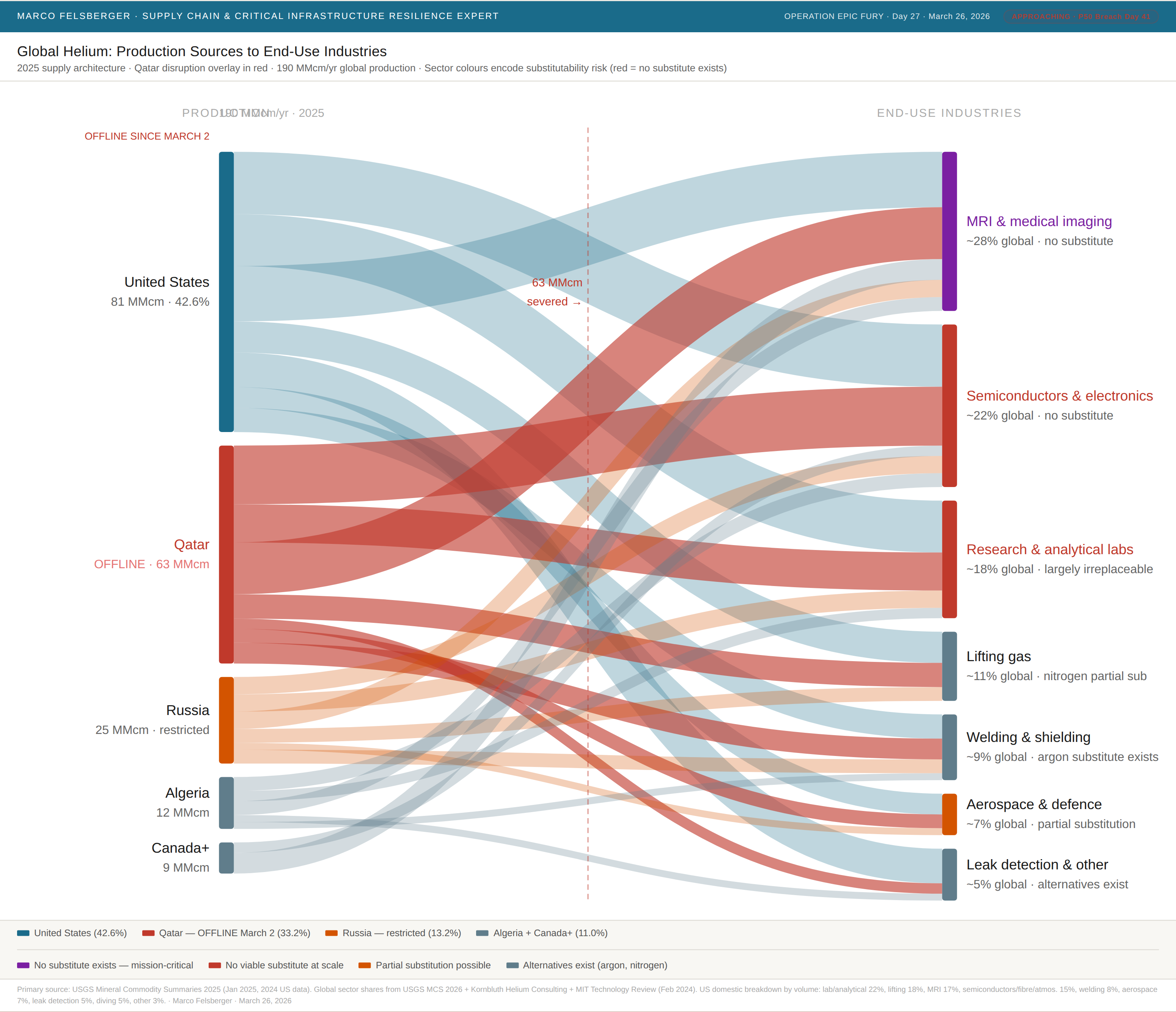
USGS(米国地質調査所)の『Mineral Commodity Summaries 2025』は、このガスがどこへ向かうかを最も明確に示している。MRIおよび医療用画像診断が世界供給量の約28%を占める。半導体および電子機器が約22%。
研究・分析ラボが約18%。上の図表のカラーコーディングは、量を超えた次元、すなわち代替可能性を表している。MRIは紫色で、物理的にいかなる規模でも代替手段は存在しない。赤は半導体で、同様だ。
灰色のセクター(溶接、リフティングガス)には部分的な代替手段がある。ヘリウム溶接にはアルゴンが代用される。気球の膨張には窒素が部分的に代用可能。しかし、クリティカルパス上の用途——つまりファブが稼働するか停止するかを決定づける用途——には、いかなる温度や純度においても代替品が存在しない。
リスクの地理的分布
すべての国が同等のリスクにさらされているわけではない。決定的な要因はカタールへの依存度、すなわち各国のヘリウム供給のうち、ラス・ラファンからの割合がどれほどかという点である。
韓国国際貿易協会(KITA)は、2025年に韓国がヘリウムの64.7%をカタールから調達していたことを確認した。フィッチ・レーティングス(3月17日)も台湾を同様のカテゴリーに分類し、「ヘリウムの大部分をカタールに依存している」と確認した。
対照的に、日本はヘリウムの約28~33%をカタールから、約50%を米国から調達しており、両国に在庫を保有している(フィッチ、2026年3月)。
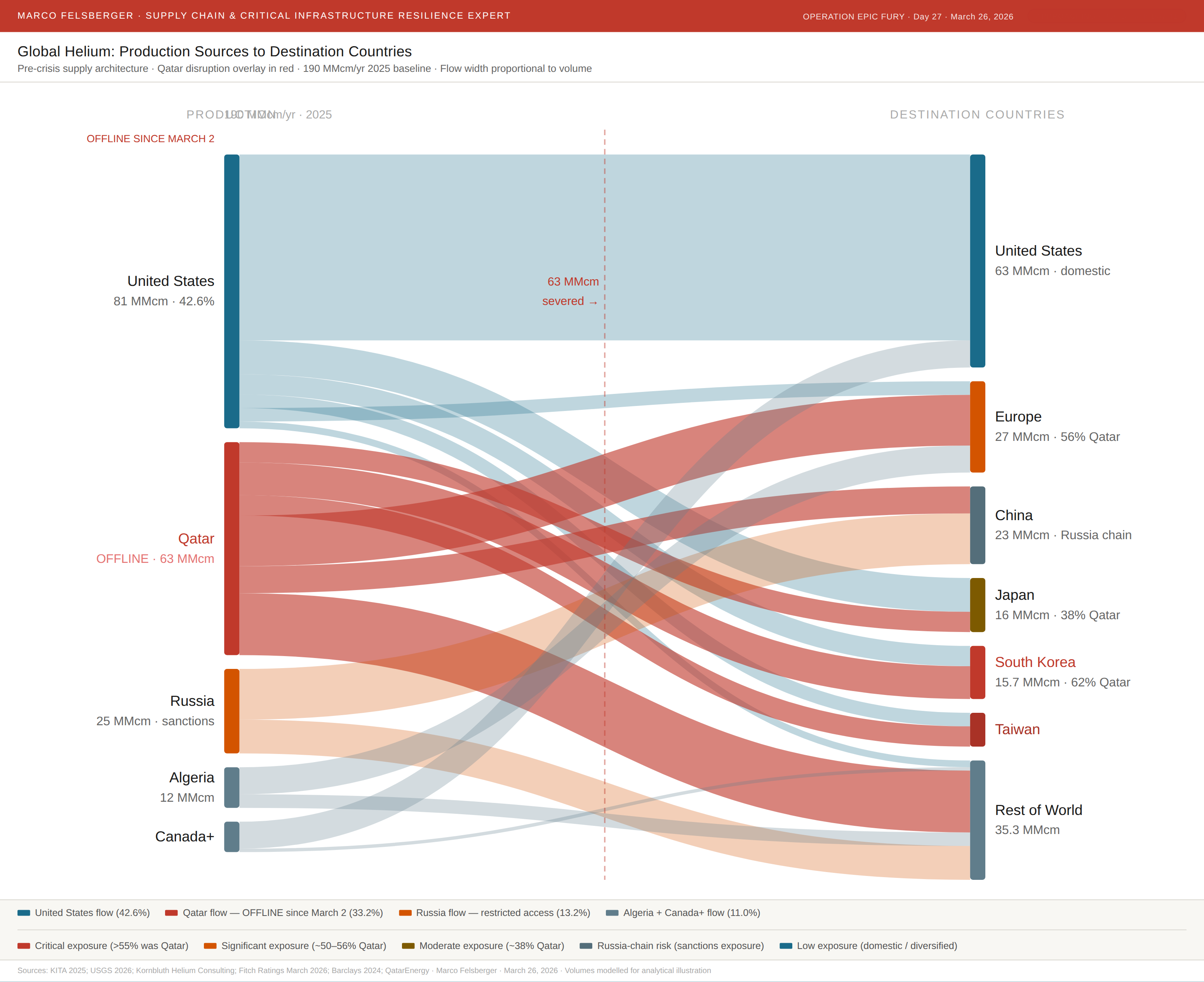
上記のフロー図は、集計統計では見えにくい構造的な問題を可視化している。米国は世界のヘリウム生産量の42%を占める。
一見すると安心できるように見えるが、その行き先を追跡してみると、圧倒的多数が長期契約を結んだ国内顧客向けであることがわかる。韓国や台湾の半導体工場は、コンテナ船の進路を変更するように、米国のスポット供給に「切り替える」ことはできない。
半導体グレードの純度を満たすサプライヤーの認定には、最低でも4~8週間を要する。米国のディストリビューターであるエアガス(Airgas)は、3月の第3週にヘリウム出荷について不可抗力を宣言した。これにより、誰もが予備の供給源だと想定していた供給源そのものが逼迫することになった。
すでに起きていること
これはもはや予測ではない。ロイターは3月26日、ヘリウムの逼迫が「世界のハイテクサプライチェーンにおける一部の生産に影響を与え始めている」と報じた。スイスの半導体製造装置メーカーVATグループの中国販売責任者ジェリー・チャン氏は、上海で開催された「セミコン・チャイナ」で、その影響を直接確認した。
エア・リキードの幹部は3月26日、短期的なヘリウム不足について警告した。リンデとエア・リキードはともに3月22日、配給体制の導入を確認した(『ディフェンス・ニュース』)。サムスンとSKハイニックスは節減策を発動した。シーゲートとウェスタンデジタルはすでに2026年のHDD生産計画を割り当て済みであり、20~30%の価格引き上げを実施している。
ヘリウムのスポット価格は3月2日以来2倍に跳ね上がっている(HPCwire、3月27日)。コーンブルース氏は、危機発生から数日以内に一部の市場で価格が70~100%上昇したと指摘した(CNBC、3月19日)。
今週発表されたJ2ソーシングの分析では、これまで十分に注目されてこなかった詳細が追加されている。2006年以降4回の供給不足サイクルを通じて市場を安定化させてきた米国土地管理局の連邦ヘリウム備蓄は、民営化が完了し、2024年半ばに2つのロットに分けて売却された。
最後の公的セクターによるショックアブソーバーは、その緩衝を目的として設計されたシナリオが発生する約18ヶ月前に、システムから取り除かれていた。
<原文>
On March 2, a third of the world’s helium supply went offline. Not for weeks. For an indeterminate period measured in months for the operational shutdown, and three to five years for the structural damage.
Most of the coverage since then has been about oil. Oil is the wrong instrument to watch.
I flagged helium as the primary non-oil supply shock in my Day 3 analysis on March 2 — before any major financial media had run the story, before Linde confirmed rationing protocols, before Airgas declared force majeure on US shipments.
The underlying exposure was sitting in USGS data and Korean trade statistics. Nobody had mapped it to a conflict scenario. This piece brings together everything I’ve established over the past 24 days and adds the dimension that emerged only this week.
What Ras Laffan actually produced
Qatar’s Ras Laffan Industrial City is not just the world’s largest LNG complex. It is the world’s largest helium production site. In 2025, it produced 63 million cubic metres — 33% of global output (USGS Mineral Commodity Summaries 2026).
Iranian drone strikes hit it on March 2. Follow-up missile strikes on March 18-19 destroyed two of fourteen LNG processing trains. QatarEnergy CEO Saad al-Kaabi confirmed the structural damage assessment publicly: those trains require three to five years to rebuild.
Force majeure was declared on March 4, releasing QatarEnergy from all supply contracts. No restart timeline has been given for the operational production that could technically resume, because the Strait of Hormuz, the only maritime exit from the Persian Gulf, remains closed to Western commercial shipping.
Unlike the Red Sea crisis of 2024, which had a Cape of Good Hope workaround adding 10-14 days per voyage, Hormuz has no bypass. It is the sole passage connecting the Gulf to the open ocean. Ships inside are trapped. Ships outside cannot enter to load.
This is the crucial difference that makes Hormuz categorically more severe than anything the global shipping industry has handled since the Tanker War of 1984-1988.
Why helium is not like any other supply disruption
Helium’s behaviour in a shortage is different from every other industrial gas.
Three properties make it uniquely dangerous:
It has no substitute in the applications that matter:
In semiconductor fabrication, helium is injected between a silicon wafer and its carrier plate to draw away heat during etching.
EUV lithography machines — the ASML instruments that print circuits at 3nm, required for every advanced AI chip, every iPhone processor, every data centre GPU — operate in helium-purged environments. No oxygen. No moisture.
Nothing that reacts. When helium runs out in a fab, these machines do not slow down. They stop. Phil Kornbluth, president of Kornbluth Helium Consulting, said at a Gasworld webinar on March 4: the world is looking at “a minimum two-to-three month shutdown of helium production and a four-to-six month period before the helium supply chain returns to normal.”
That was the estimate before the March 18-19 structural damage changed the medium-term supply picture.
It is a byproduct, not a primary product:
Helium is captured during LNG processing, it comes out when the gas plant runs, and only then. QatarEnergy cannot decide to restart helium production while the Strait is closed and LNG exports are blocked.
The operational shutdown, the structural damage, and the Hormuz closure are not three separate problems. They are one problem with three layers, each with a different resolution timeline. A ceasefire this week would not reopen helium flows next week.
It escapes permanently:
Helium is lighter than air and reaches atmospheric escape velocity from the upper atmosphere. Every molecule that vents from a damaged container, an imperfect gasket, or a stranded cryogenic tank is gone — not recyclable, not recoverable.
Approximately 200 specialized ISO containers carrying liquid helium at −269°C are stranded in the Middle East. Each holds helium safely for 35 to 48 days before boiloff through pressure relief valves. The oldest containers loaded before March 2 have been in that window for over three weeks.
The USGS Mineral Commodity Summaries 2025 gives the clearest picture of where this gas goes. MRI and medical imaging takes roughly 28% of global supply. Semiconductors and electronics approximately 22%.
Research and analytical labs around 18%. The colour coding in the chart above encodes a dimension beyond volume: substitutability. Purple for MRI, physically no alternative exists at any scale. Red for semiconductors, same.
The grey sectors (welding, lifting gas) have partial alternatives. Argon substitutes for helium welding. Nitrogen can partially substitute for balloon inflation. But the critical-path uses — the ones that determine whether a fab runs or stops, have no substitutes at any temperature or purity.
The geography of exposure
Not all countries are equally exposed. The binding variable is Qatar dependency: what fraction of each country’s helium came from Ras Laffan.
The KITA (Korea International Trade Association) confirmed Korea sourced 64.7% of its helium from Qatar in 2025. Fitch Ratings (March 17) placed Taiwan in the same category, confirming it “relies on Qatar for the majority of its helium.”
Japan, by contrast, sourced approximately 28-33% from Qatar and roughly 50% from the US, with inventory held in both countries (Fitch, March 2026).
The flow map above makes the structural problem visible in a way that aggregate statistics obscure. The US produces 42% of global helium.
That looks reassuring until you trace where it goes: overwhelmingly to domestic customers under long-term contracts. Korean and Taiwanese fabs cannot “redirect” to US spot supply the way you redirect a container ship.
Supplier qualification for semiconductor-grade purity takes four to eight weeks minimum. US distributor Airgas declared force majeure on helium shipments in the third week of March — tightening the very supply everyone assumed was the fallback.
What is already happening
This is no longer a forecast. Reuters reported on March 26 that helium tightness “has started affecting some production in the global tech supply chains.” Jerry Zhang, China sales head at Swiss semiconductor equipment firm VAT Group, confirmed the impact directly at Semicon China in Shanghai.
An Air Liquide executive warned on March 26 of a short-term helium shortage. Linde and Air Liquide both confirmed rationing protocols on March 22 (The Defense News). Samsung and SK Hynix have activated conservation protocols. Seagate and Western Digital have already allocated 2026 HDD production and implemented price increases of 20-30%.
Spot helium prices have doubled since March 2 (HPCwire, March 27). Kornbluth put the rise at 70-100% in some markets within days of the crisis beginning (CNBC, March 19).
The J2 Sourcing analysis published this week adds a detail that has received insufficient attention: the US Bureau of Land Management’s Federal Helium Reserve — which stabilized the market through four shortage cycles since 2006 — completed privatization and was sold in two lots in mid-2024.
The last public-sector shock absorber was removed from the system roughly 18 months before the scenario it was designed to buffer.